the Mind-Body Connection
Homework Exercise
from the MBSR Workbook
Take some time to reflect on the following questions, noticing whatever comes up in your thoughts, feelings, and sensations. When you’re ready, write some of your thoughts in your notebook. You may have more to write for some questions than for others; this is fine.
- How is stress or anxiety about people affecting your life?
- How is stress or anxiety about work affecting your life?
- How is stress or anxiety about the world affecting your life?
- How is stress or anxiety about food or eating habits affecting your life?
- How is stress or anxiety about sleep and sleeplessness affecting your life?
- How is stress or anxiety about exercise or lack of physical activity affecting your life?
Meditation
from the MBSR Workbook
Five-Minute Mindful Breathing
The deepest healing occurs when you come to terms with the way things are. This might mean simply noticing and acknowledging stress or anxiety rather than falling into old patterns of running away from it. You may discover that by embracing your fear you find your heart.
Neuroplasticity
In laymen terms, Neuroplasticity is the change in how the nerves work. It’s the ability of the brain to change its functions and properties. This change could be brought about by a behavioral change, environmental change, change in thoughts and emotions and also a change due to any physical injury.

Neuroplasticity is widely used in a lot of therapeutic exercises. Therapists and psychologists work with people going through anxiety disorders and depression to change their emotional and mental health through changing synapses.
- Recognize potential bad habits
- Recognize the triggers
- Plan out how you want to change
Check-in
- Emotions present (anger, fear, joy, sadness, sexual/creative)
- Physical sensations
- Next thought
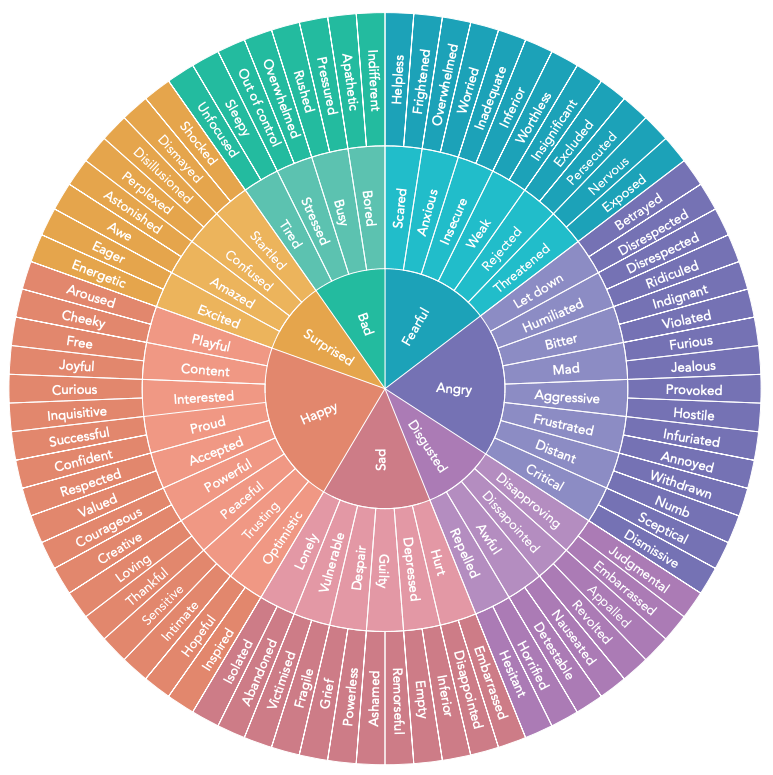
Click to enlarge
Nourishing or Depleting Activities?
One very effective way to realign the way we live is to make a list of every activity that we engage in throughout the course of a regular day, and note whether each activity nourishes or depletes us.
Quickly, we will come to see the patterns and habits that enrich our lives and those that don’t. Once we do this, we have a more realistic picture of what areas of our lives we want to make changes to.
List your daily activities with as much detail as possible and then categorize them as nourishing (N), depleting (D), neither, or both.
| Tea in bed | N |
| Check the headlines, emails, Facebook | D |
| Shower | N |
| Breakfast or coffee & leftover Chinese | D |
| Drive to work | D |
| Conversation w/ raging coworker about other oblivious coworker | D |
| Quiet morning of focused work | N |
| Lunch in park | N |
STOP Technique
A version of a mindful check-in
The STOP Technique is a mindfulness-based practice designed to help you defuse stress in the moment.
Creating space in the day to pause, slow down a racing mind, and get back into the present moment has been shown to be incredibly helpful in reducing the the negative effects of stress.
Taking a brief pause—even for less than one minute—can help you gain perspective and determine the best possible action you can take next.
- Stop
Interrupt your thoughts with the command ‘stop!’ and pause whatever you’re doing. - Take a breath
Notice your breathing for a second. Breathe in slowly through the nose,
expanding the belly, and exhale slowly and deeply through pursed lips. - Observe
Become the observer of your thoughts, emotions and physical reactions. What thoughts do you notice? What emotions are present? How does your body feel? Tune in and sit with whatever arises for a few moments. - Proceed
Mindfully consider how you’d like to respond. What’s one thing you can focus on right now? What’s your most important and urgent priority? Narrow down your focus and take it one small step at a time.
 Dani's Mindfulness Group Madness